Basketball June 21, 2026
Do NBA G League Players Get Paid? Salaries, Benefits, and the Path to the Pros
NBA G League Salary Estimator
Select Player Profile
Entry Level
Average
Top Performer
Two-way contracts are prorated based on time spent in the NBA vs G League.
Estimated Annual Income
$35,000
Rookie Standard
Salary Scale Comparison:
$0
$500k+
Note: This is a baseline estimate. Actual salaries vary by team and negotiation.
You watch a game on ESPN or check your fantasy app, seeing names like Nikola Jokić or Luka Dončić earning tens of millions. Then you look at the NBA G League, the official minor league of the National Basketball Association. The talent is undeniable. The athleticism is high. But when you ask, "Do they get paid?" the answer isn't as simple as yes or no.
The short answer is yes. G League players are professionals who receive salaries. However, the amount varies wildly depending on their contract type, experience, and whether they are assigned from an NBA team. Understanding this financial landscape is crucial for anyone following the development of young athletes or considering a career in professional basketball outside the top tier.
The Baseline: Standard Player Contracts
For the majority of players in the league, income comes through standard contracts. These agreements are governed by the Collective Bargaining Agreement (CBA) between the G League and the players' association. Since the 2017-2018 season, the minimum salary has seen significant increases, reflecting the growing professionalism of the league.
In the current era, a standard rookie contract typically starts around $35,000 to $40,000 per season. This might sound low compared to NBA wages, but it represents a substantial increase from previous years where some players made less than $15,000. Veteran players with more experience can earn significantly more, often reaching six figures. Top performers in the G League, those who consistently put up impressive stats and attract NBA attention, can command salaries upwards of $100,000 to $150,000.
This structure ensures that even entry-level professionals have a baseline income to cover living expenses while they pursue their dreams. It’s not wealth-building money, but it allows players to focus entirely on training and games without needing a second job.
The Two-Way Contract Revolution
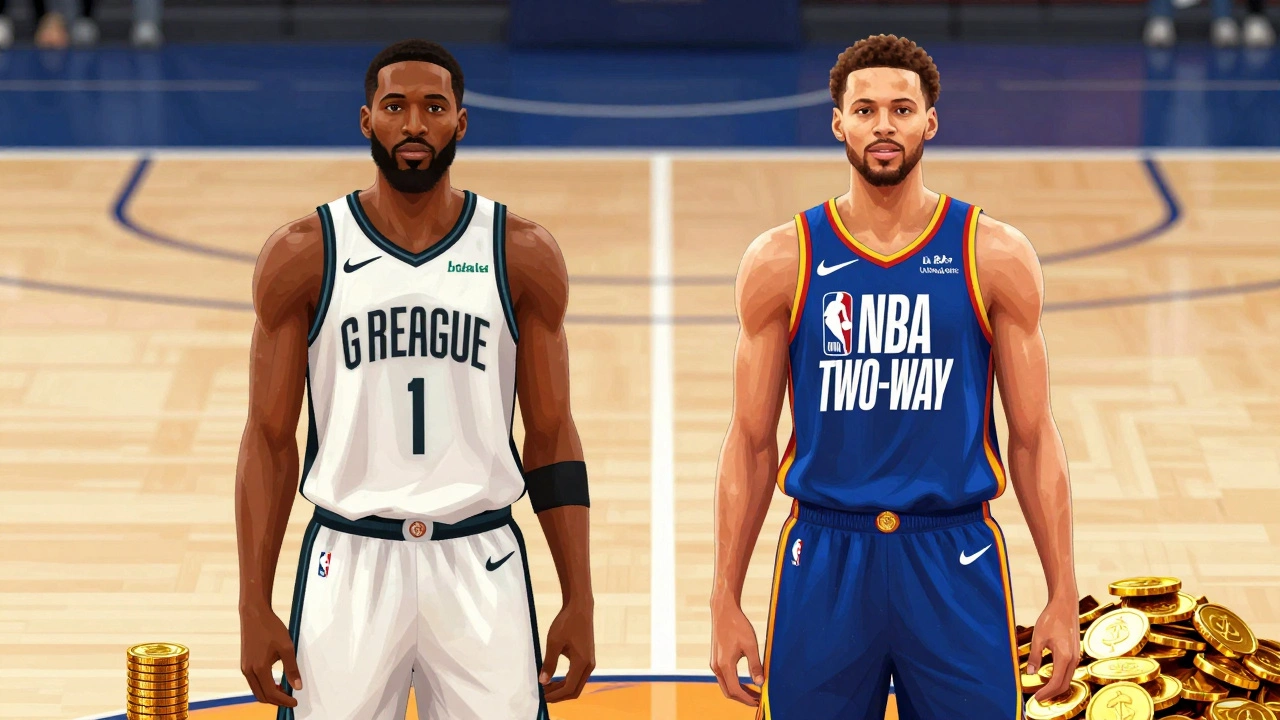
If you’re watching the NBA today, you’ll notice many rosters include players designated as "Two-Way." This is a critical concept for understanding modern basketball finances. Introduced in the 2017 CBA, Two-Way Contracts allow teams to carry three additional players who split time between the NBA and the G League.
Why does this matter for pay? Because Two-Way players earn a fraction of the NBA minimum salary, which is drastically higher than standard G League pay. In recent seasons, a Two-Way player can earn between $250,000 and $500,000 annually, depending on how many days they spend with the NBA parent club versus the G League affiliate. This creates a massive disparity within the same arena. One teammate might be making $40,000, while another, just across the court, is making half a million dollars because he holds a Two-Way deal.
This system incentivizes performance. If a G League player performs well enough, his NBA parent team can promote him to a Two-Way contract, instantly multiplying his income. It’s a powerful carrot dangling in front of every aspiring pro.
Exhibit 10 Deals: The College Pipeline
Another major source of income and opportunity comes from college basketball. When an NBA team drafts a player or signs a free agent out of college, they can offer an Exhibit 10 contract. This is a special clause in a standard NBA two-year contract that includes a bonus if the player agrees to play for the team’s G League affiliate during the offseason.
Here’s how it works: The player signs with the NBA team but doesn’t make the final roster. Instead of being cut with nothing, he goes to the G League. If he stays there for the entire summer league and preseason period, he receives a guaranteed bonus, usually ranging from $25,000 to $50,000. This provides a safety net for young players transitioning from amateur sports to the professional world.
These deals are common for late-round draft picks and undrafted free agents. They represent a bridge between college scholarships and full-time professional salaries. For many players, this bonus is the difference between financial stress and stability during their first year in the pros.
Benefits Beyond the Paycheck
Salary isn’t the only form of compensation. Professional athletes require extensive support systems to maintain peak physical condition. G League players receive several non-monetary benefits that add significant value to their employment.
- Health Insurance: All players on standard contracts receive comprehensive health insurance, covering medical, dental, and vision care. This is invaluable for athletes who face high risks of injury.
- Travel Accommodations: Teams cover all travel costs, including flights, hotels, and meals during away games. Players don’t pay out of pocket for transportation.
- Training Facilities: Access to professional-grade gyms, weight rooms, and recovery centers is included. Many affiliates share facilities with their NBA parent clubs, giving players access to elite resources.
- Equipment: Shoes, jerseys, and practice gear are provided by sponsors and the league.
While these benefits don’t hit the bank account directly, they reduce living expenses and allow players to invest more in their careers. For example, having health insurance means a knee injury won’t lead to bankruptcy-a real fear for independent contractors.
Financial Challenges and Realities
Despite these improvements, financial pressure remains a reality for many G League players. A $40,000 salary must stretch across a season that includes travel, personal needs, and sometimes family support. Unlike NBA stars, G League players rarely have agents negotiating lucrative endorsement deals. Sponsorships are scarce, and most players rely solely on their salary.
Many players come from modest backgrounds and use their earnings to support families back home. Others save aggressively, hoping for a breakthrough moment that lands them an NBA call-up. The uncertainty is part of the job. One day you’re playing; the next, you might be waived. This instability requires careful financial planning and discipline.
Some players take on side jobs during the off-season, such as coaching youth leagues or working retail, to supplement their income. While the league encourages full-time focus on basketball, economic realities often dictate otherwise.
| Contract Type | Typical Annual Salary Range | Key Characteristics | Best For |
|---|---|---|---|
| Standard G League Rookie | $35,000 - $45,000 | Entry-level, one-year term, basic benefits | Undrafted prospects, rookies |
| Veteran G League Pro | $60,000 - $150,000+ | Experience-based raises, leadership roles | Seasoned players, international imports |
| Two-Way Contract | $250,000 - $500,000+ | Splits time between NBA and G League, prorated pay | Players on NBA bubble, developmental talents |
| Exhibit 10 Bonus | $25,000 - $50,000 (Bonus) | Added to NBA contract, requires summer commitment | College draftees, free agents |
The Global Perspective: International Players
A significant portion of the G League roster consists of international players. For athletes from Europe, Africa, Asia, and South America, G League salaries can be highly competitive compared to domestic leagues in their home countries. A $50,000 salary in the United States may equate to a middle-class or upper-middle-class income elsewhere, especially when converted to local currencies.
International players also bring diversity and skill sets that elevate the level of play. They often have different styles of basketball, emphasizing fundamentals and team play over individual athleticism. This cross-cultural exchange enriches the league and helps prepare American players for global competition.
However, international players face additional challenges, such as visa restrictions and distance from family. Some choose shorter contracts to remain flexible, allowing them to return home or sign with European clubs if opportunities arise. The G League serves as a testing ground, proving their worth before moving to larger markets abroad.
Pathways to Higher Earnings
So, how do players move from modest G League salaries to life-changing NBA wealth? The path is narrow but clear. Performance is king. Scouts from NBA teams attend G League games regularly, looking for flashes of brilliance, consistent improvement, and professional attitude.
- Summer League: Many G League players participate in NBA Summer League events. Impressing coaches here can lead to training camp invites.
- Injury Replacements: When an NBA star gets hurt, teams often call up their best G League affiliate players. Performing well in limited minutes can secure a longer-term deal.
- Statistical Dominance: Leading the league in scoring, rebounding, or efficiency catches eyes. Awards like G League MVP signal readiness for the next level.
- Networking: Building relationships with coaches, trainers, and former teammates opens doors. Reputation matters as much as stats.
Success stories like Trey Burke or Drew Eubanks show that the G League is a legitimate stepping stone. Their journeys prove that hard work and resilience can turn a modest salary into a multimillion-dollar career.
What is the average salary of an NBA G League player?
The average salary varies widely. Rookies start around $35,000-$40,000, while veterans can earn $100,000+. Two-Way players earn significantly more, averaging $250,000-$500,000. The overall average leans toward the lower end due to the number of entry-level players.
Do G League players get health insurance?
Yes, all players on standard contracts receive comprehensive health insurance, including medical, dental, and vision coverage. This is a key benefit provided by the league and teams.
Can G League players make more money overseas?
It depends on the player's profile. Top-tier G League talents might find better offers in strong European leagues. However, mid-level players often earn more in the G League than in lesser-known international leagues, especially when factoring in benefits and exposure.
How does a Two-Way contract affect G League pay?
A Two-Way contract allows a player to split time between the NBA and G League. Their salary is prorated based on days spent with each team. Even spending most of the season in the G League, they earn far more than standard G League players due to the NBA minimum salary floor.
Is the G League salary enough to live on?
For a single person in a moderate-cost area, yes. With housing assistance or team-provided accommodations, many players manage comfortably. However, supporting a family or saving aggressively can be challenging on a rookie salary, requiring budgeting and financial discipline.