Tennis Tournaments May 17, 2026
What Is an 8.0 Ranking in Tennis? Understanding NTRP Levels
Tennis Rating Converter & Checker
Convert Your Rating
Compare your skill across different systems.
Your Level:
Warning:
Quick Reference Guide
| NTRP (Higher = Better) |
WTN (Lower = Better) |
Skill Description |
|---|---|---|
| 1.0 - 2.5 | 8.0 - 10.0 | Beginner / Learning |
| 3.0 - 3.5 | 6.0 - 7.5 | Intermediate / Recreational |
| 4.0 - 4.5 | 4.0 - 5.5 | Advanced / Competitive |
| 5.0 - 5.5 | 2.0 - 3.5 | Elite Amateur / Ex-College |
When you hear someone say they have an "8.0 ranking" in tennis, it can be confusing. If you look at the professional tour, the top players like Jannik Sinner or Iga Swiatek are ranked number 1, not 8.0. So, where does this decimal number come from? The short answer is that 8.0 ranking refers to the National Tennis Rating Program (NTRP), a system used primarily in the United States and Canada to gauge amateur player ability.
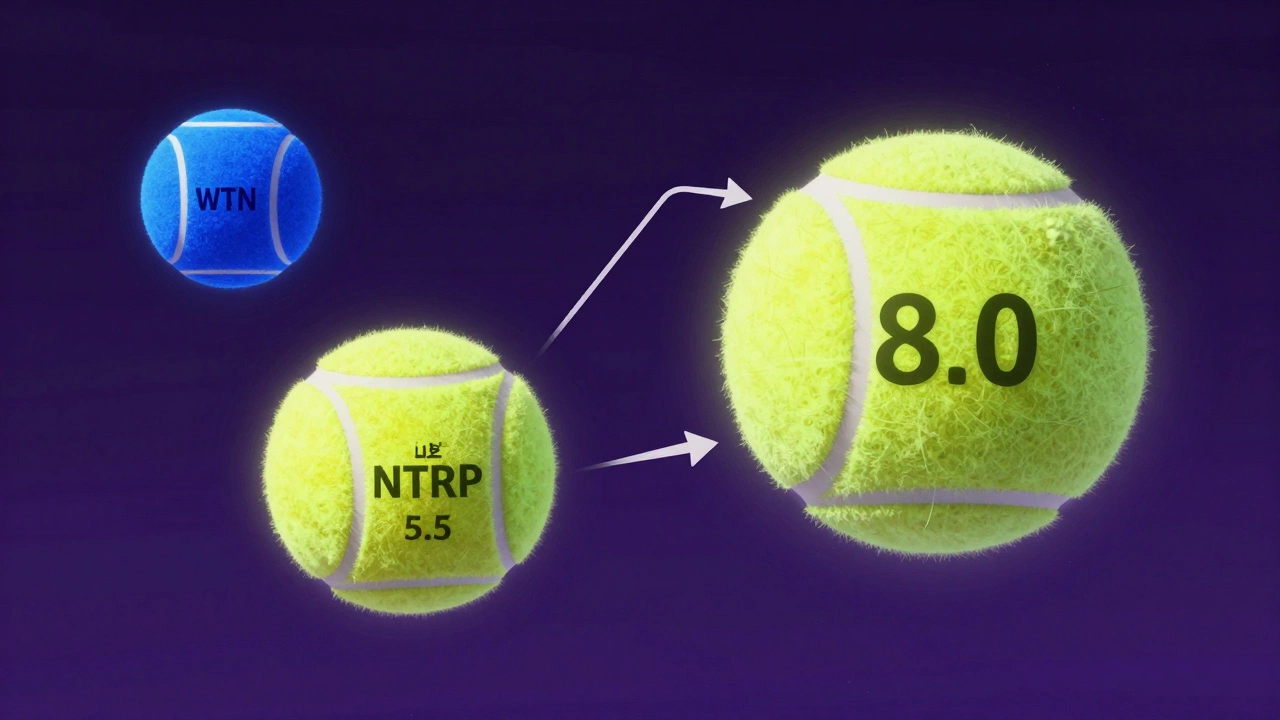
However, here is the catch: there is no such thing as an 8.0 level in the standard NTRP system. The scale tops out at 5.5. If someone claims to be an 8.0, they are either mistaken, joking, or referring to a completely different, non-standard metric. To understand why this confusion happens, we need to break down how tennis ratings actually work, both for amateurs and professionals.
The NTRP Scale: The Standard for Amateur Tennis
National Tennis Rating Program (NTRP) is
a standardized rating system used by the United States Tennis Association (USTA) and Tennis Canada to evaluate the skills of recreational players.
It was created to help players find opponents of similar skill levels, ensuring matches are competitive and enjoyable rather than one-sided blowouts.
The NTRP scale runs from 1.0 to 5.5 in increments of 0.5. Each level represents a specific set of technical skills, tactical awareness, and physical consistency. Here is what the upper end of the scale looks like:
- 4.0: A strong all-court player who has developed a variety of shots with power and spin. They can handle fast-paced play and have basic strategic understanding.
- 4.5: A very good competitor who can execute most shots with depth, speed, and direction. They may lack the consistency of a higher-level player but can dominate lower-rated opponents.
- 5.0: An excellent all-around competitor who possesses advanced movement patterns and shot-making abilities. They can compete in local tournaments and win consistently against other 5.0s.
- 5.5: The highest amateur rating. These players are often former college varsity athletes or current junior national team members. They have exceptional court coverage, explosive power, and advanced tactics.
Notice that 5.5 is the ceiling. This means that even the best amateur club players in the world do not exceed a 5.5 NTRP rating. If you see a rating above 5.5, it is not part of the official USTA or Tennis Canada framework.
Professional Rankings: The ATP and WTA Systems
If the NTRP system doesn't go up to 8.0, maybe the person meant professional rankings? In professional tennis, the Association of Tennis Professionals (ATP) for men and the Women's Tennis Association (WTA) for women use a points-based system. Players accumulate points by winning matches in tournaments of varying prestige.
The rankings are ordinal numbers: 1, 2, 3, etc. There is no decimal point involved. Being ranked "number 8" is a significant achievement, placing a player among the top eight in the world. However, nobody says they are "8.0." They simply say they are "ranked number 8."
For context, being ranked number 8 in the world means you are a Grand Slam contender. You would likely win multiple ATP 1000 or WTA 1000 titles per year. This is a far cry from the recreational context where NTRP ratings are usually discussed.
Where Does "8.0" Come From?
Since neither the amateur NTRP system nor the professional ATP/WTA systems use an 8.0 rating, where does this number originate? There are three likely scenarios:
- Confusion with Other Sports: Some sports use different rating scales. For example, bowling averages can reach into the hundreds, and golf handicaps can vary widely. A user might be mixing up rating systems.
- Private Coaching Metrics: Some private coaches or local clubs create their own internal grading systems. They might use a 1-10 scale for simplicity, where 10 is a pro and 1 is a beginner. In this hypothetical scenario, an 8.0 might represent a high-level collegiate or semi-professional player. However, this is not standardized and holds no value outside that specific club.
- Misunderstanding of ITF World Tennis Number: The International Tennis Federation (ITF) introduced the World Tennis Number (WTN) to provide a global standard. The WTN uses a scale from 1 to 10, but unlike NTRP, a higher number indicates a lower skill level. A 1.0 is a professional, while a 10.0 is a beginner. Therefore, an 8.0 on the WTN scale would actually indicate a fairly low-skilled recreational player, not an expert.

Comparing Rating Systems
To clear up the confusion, let's compare the major tennis rating systems side-by-side. This will help you identify which system might be in use when you hear a specific number.
| System | Scale Range | Direction | User Base | Highest Skill Level |
|---|---|---|---|---|
| NTRP | 1.0 - 5.5 | Higher = Better | USA & Canada Amateurs | 5.5 |
| ATP/WTA | 1 - 1000+ | Lower = Better | Professionals | 1 |
| World Tennis Number (WTN) | 1 - 10 | Lower = Better | Global Recreational | 1.0 |
| UCR (College) | 1 - 99 | Lower = Better | US College Players | ~1-5 |
As you can see, none of these systems feature an "8.0" as a top-tier rating. The NTRP stops at 5.5. The WTN goes to 10, but 8.0 is near the bottom. The ATP/WTA rankings are integers only.
How to Determine Your True Level
If you are trying to figure out your own level, don't rely on self-assessment alone. Many players overestimate their abilities. Here is how to get an accurate rating:
- Play League Tennis: Join a USTA league. You will be assigned a starting rating based on your results. This is the most common way Americans discover their true NTRP level.
- Take a Self-Assessment Test: The USTA provides detailed checklists for each NTRP level. Be honest about your consistency under pressure. Can you hit 10 consecutive forehands without error? If not, you might not be a 4.0 yet.
- Use the World Tennis Number: If you are outside North America, the WTN is more accessible. It uses AI and match history to calculate your rating dynamically.
Why Accurate Ratings Matter
You might wonder why getting the number right matters so much. The primary reason is enjoyment. Playing against someone significantly better than you leads to frustration. Playing against someone significantly worse leads to boredom. Accurate ratings ensure that matches are close, competitive, and fun.
Furthermore, accurate ratings protect your safety. Higher-level players hit the ball faster and harder. If a 5.5 plays a 3.0, the 3.0 is at risk of injury due to the inability to react to powerful shots. Proper classification keeps everyone safe.
Common Misconceptions About Tennis Rankings
Beyond the "8.0" myth, there are other common misunderstandings about tennis rankings that new fans often encounter.
First, many people confuse "ranking" with "seed." In a tournament, seeds are determined by ranking, but they are temporary positions within that specific event. A player ranked number 10 in the world might be seeded number 1 in a smaller tournament if the top nine players do not participate.
Second, some believe that rankings are static. In reality, ATP and WTA rankings change every week based on a rolling 52-week period. Points drop off as old tournaments expire, meaning players must constantly perform well to maintain their position.
Finally, there is a misconception that NTRP ratings are permanent. They are not. As you improve, your rating should increase. Conversely, if you stop playing for years, your rating may decrease. The system is designed to reflect your current ability, not your peak potential.
Is there an 8.0 level in the NTRP system?
No, the NTRP system maxes out at 5.5. Any rating above 5.5 is not part of the official United States Tennis Association or Tennis Canada standards.
What does an 8.0 mean in the World Tennis Number?
In the World Tennis Number (WTN) system, a lower number is better. An 8.0 indicates a beginner to intermediate recreational player who is still developing basic consistency and strategy.
Can I be ranked number 8 in the world?
Yes, but this refers to the ATP or WTA professional rankings. Being ranked number 8 means you are one of the eight best active professional players in the world, not that you have a score of 8.0.
How do I find my NTRP rating?
The best way is to join a USTA league or take the official USTA self-assessment test. Private coaches can also provide estimates, but league play offers the most objective data based on match results.
What is the difference between NTRP and WTN?
NTRP is used primarily in North America and ranges from 1.0 to 5.5, with higher numbers indicating better skill. WTN is global, ranges from 1 to 10, and works inversely, with lower numbers indicating better skill.