Sports Equipment November 23, 2026
What is a Rugby Ball Called? History, Specs, and Names
Rugby Ball Selector & Spec Checker
Not sure which ball you need? Select your player's details below to find the recommended size and view the official World Rugby specifications for that size.
Player Details
Enter the player's current age.
Select Age & Gender
Results will appear here with specific dimensions and weight limits.
You see it on the pitch, you kick it, you pass it, and you definitely tackle people with it. But if someone asked you to name that specific piece of equipment right now, what would you say? Most people just call it a "rugby ball." Technically, that’s correct in casual conversation, but it misses the nuance. The object itself has a specific shape, a regulated size, and a history that explains why it looks nothing like a soccer ball or an American football.
So, what is a rugby ball called? In official terms, it’s simply a "rugby ball," but its defining characteristic is its prolate spheroid shape. Unlike the spherical balls used in most team sports, this oval design allows for unpredictable bounces and easier handling when wet. Understanding the terminology helps you appreciate the game more, whether you’re watching a Six Nations match or playing touch rugby at the local park. Let’s break down exactly what we’re talking about, where the name comes from, and why the shape matters so much.
The Official Name and Shape
There isn’t a secret code name for the rugby ball. It is officially known as a rugby ball, which is an oval-shaped ball used in the sport of rugby union and rugby league. However, describing it merely as "oval" is lazy geometry. The precise mathematical term is a prolate spheroid, which is a three-dimensional ellipsoid formed by rotating an ellipse around its major axis.
Why does this matter? Because the shape dictates how the ball behaves. A sphere rolls predictably. A prolate spheroid wobbles. When you drop a rugby ball, it doesn’t roll straight; it hops and changes direction randomly. This makes catching harder and kicking more challenging. If you’ve ever tried to bounce-pass a soccer ball, you know it goes where you expect. Try bouncing a rugby ball, and you’ll realize you need to account for chaos.
The dimensions are strictly regulated by World Rugby, the global governing body. For men’s senior matches (Size 5), the ball must be between 280mm and 300mm in length, with a circumference of 740mm to 770mm. Women’s matches use Size 4 balls, which are slightly smaller and lighter. These specs aren’t arbitrary; they ensure fairness across leagues worldwide.
Why Is It Not Called a Football?
This is where things get confusing because "football" means different things depending on where you live. In the US, football refers to the NFL style game. In the UK, Australia, and New Zealand, "football" often refers to association football (soccer) or Australian Rules Football. So, calling a rugby ball a "football" creates ambiguity.
Historically, though, rugby was a type of football. The game originated in England in the early 19th century as a variant of folk football games. The split happened at Rugby School in 1823, when William Webb Ellis allegedly picked up the ball and ran with it. Before that, most footballs were round. The first rugby balls were actually made from inflated pig bladders covered in leather. Pig bladders don’t hold air perfectly round; they naturally form an irregular oval shape. Over time, manufacturers standardized this accidental shape because players preferred it for carrying and passing.
Today, we distinguish between codes. Rugby Union uses a slightly larger, rounder ball compared to Rugby League, which uses a more pointed, elongated ball designed for faster passing and kicking. American footballs are even more pointed and have laces for gripping, which rugby balls lack entirely.
Materials and Manufacturing Evolution
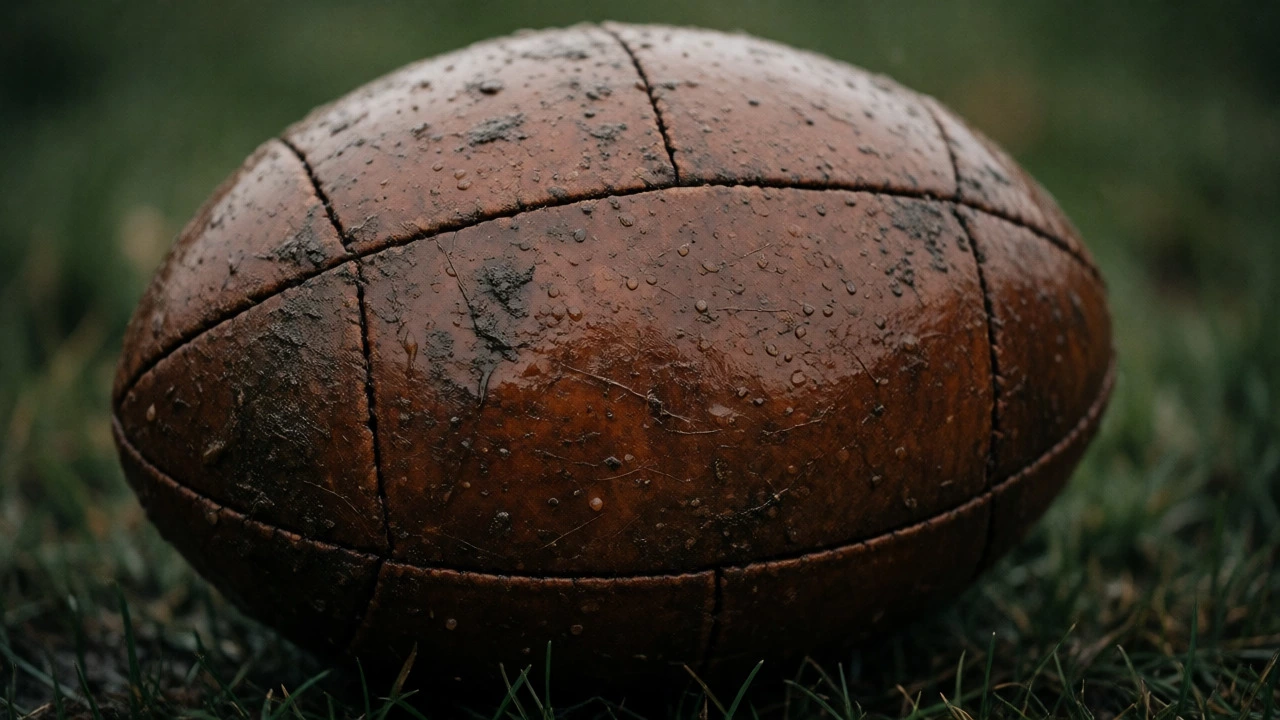
If you held a rugby ball from 1900, your hands would hurt after ten minutes. Early balls were made from four panels of thick, stiff leather stitched together. They absorbed water like sponges. By halftime, a ball could weigh twice as much as it did at kickoff. Imagine tackling someone while holding a two-pound brick.
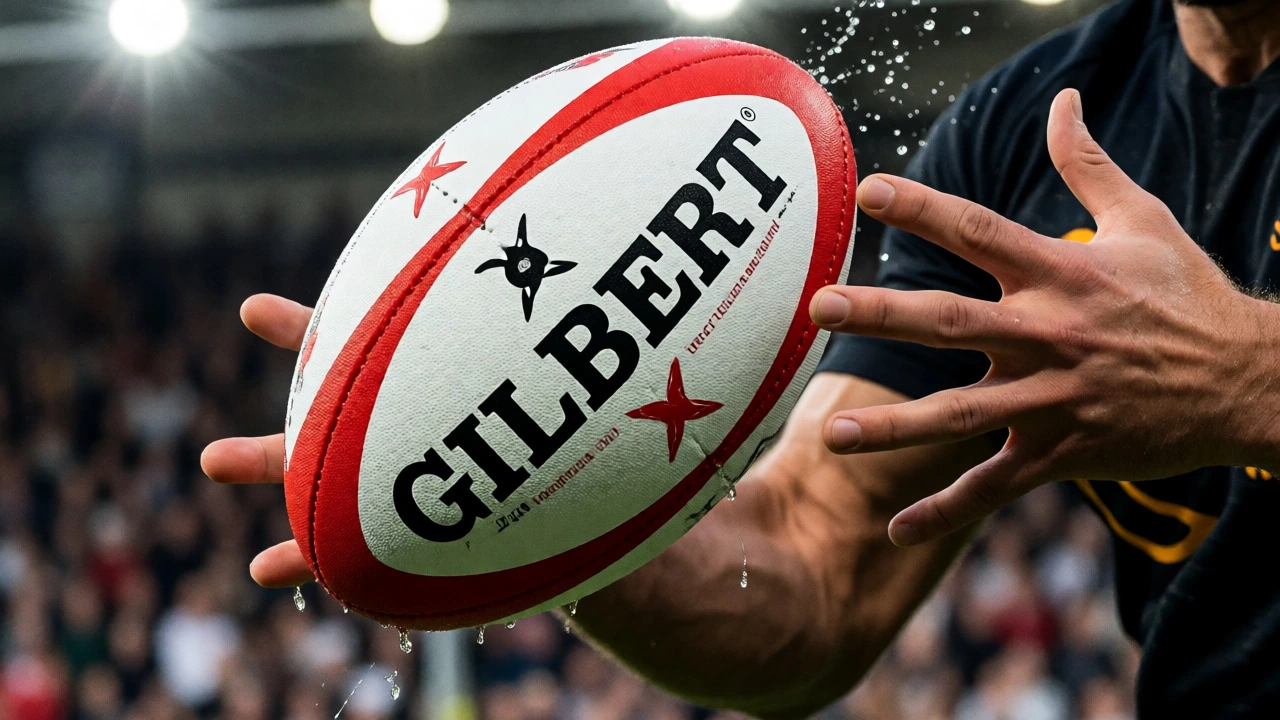
The modern synthetic rugby ball is a marvel of engineering. Today’s balls typically use polyurethane or rubber bladders with textured synthetic outer covers. These materials repel water, maintain consistent weight, and provide grip even when muddy. Brands like Gilbert, Mitre, and Steeden dominate the market. Gilbert, for instance, supplies balls for many international tests and club competitions.
The construction usually involves four curved panels stitched or glued together. High-end match balls feature hand-stitched seams for better aerodynamics and durability. Training balls might use machine stitching or molded designs, which are cheaper but less durable. The inner bladder holds the air pressure, typically between 6.5 and 10 psi (pounds per square inch). Getting this pressure right is crucial. Too soft, and it won’t kick far; too hard, and it hurts to catch.
Comparison: Rugby vs. Other Oval Balls
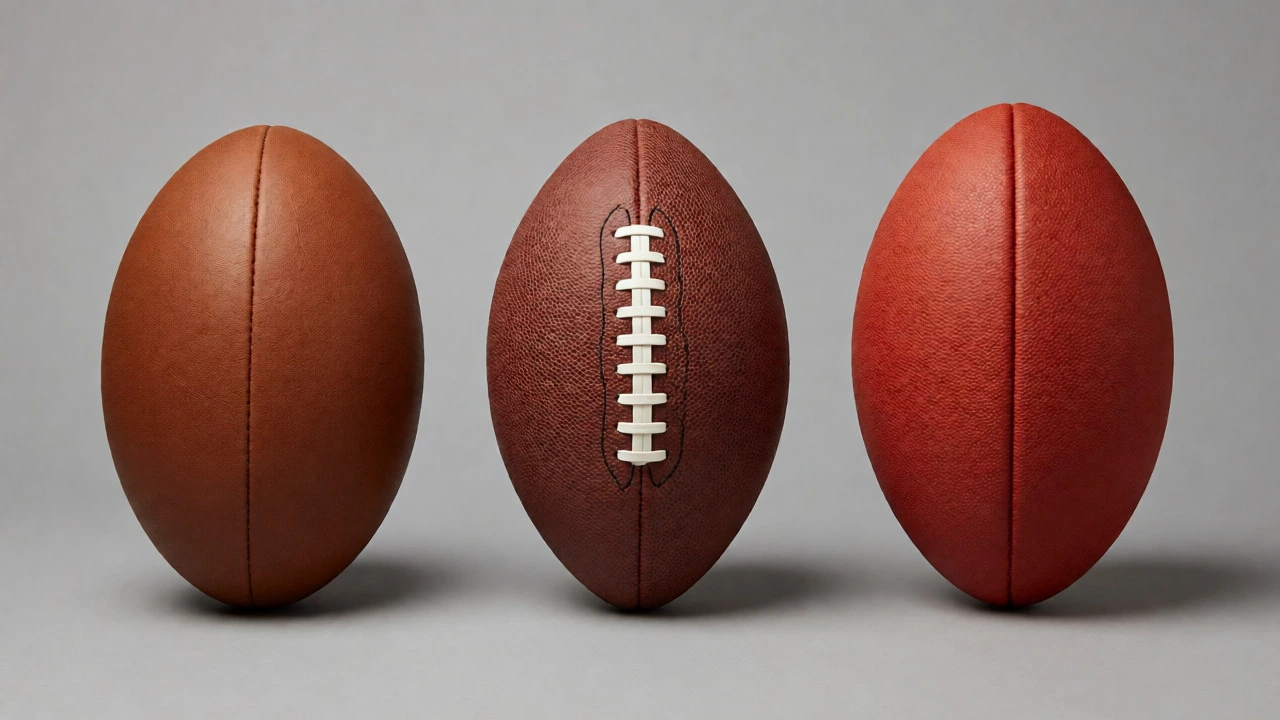
People often confuse rugby balls with American footballs or Australian Rules footballs. While they share the prolate spheroid family tree, their attributes differ significantly. Here is a quick breakdown to help you spot the differences instantly.
| Feature | Rugby Union Ball | American Football | Australian Rules Ball |
|---|---|---|---|
| Shape | Rounder ends, wider girth | Pointed ends, narrower girth | Similar to Rugby Union but slightly larger |
| Laces | No laces | Prominent white laces for grip | No laces |
| Weight (approx) | 410-460g (Size 5) | 397-425g | 450-500g |
| Primary Use | Kicking, passing, carrying | Throwing, kicking, running | Kicking, marking, running |
| Grip Texture | Textured dimples/patterns | Smooth leather with pebbled grip | Textured synthetic |
Notice the lack of laces on the rugby ball. This forces players to develop strong grip strength and proper passing technique. You can’t rely on fingers digging into lace holes. Instead, you cradle the ball against your chest or use fingertips on the textured surface. This subtle difference shapes the entire skill set required for the sport.
Cultural Slang and Nicknames
While "rugby ball" is the formal term, fans and players have plenty of slang. In Australia, you might hear "pillow" due to its softer feel compared to old leather balls. In South Africa, Afrikaans speakers sometimes refer to it as "bal," which just means ball, but context clarifies the sport.
Another common nickname is "the egg." This stems from its resemblance to a large chicken egg, especially older, brown leather models. Young players often joke about "catching the egg" when they fumble a high ball. It’s not an official term, but it sticks because it’s visual and funny.
Don’t confuse these nicknames with brand names. Sometimes people say "grab the Gilbert" instead of "grab the ball," similar to how people say "Kleenex" for tissues. Gilbert is such a dominant brand in professional rugby that the product name has become genericized in some circles. Just remember, if you ask for a "Gilbert" at a general sports store, clarify you want a rugby ball, not a cricket bat or a tennis racket cover.
Choosing the Right Ball for Your Needs
If you’re buying a ball, the question isn’t just what it’s called, but which one you need. Sizes vary by age and gender. Using the wrong size affects development and safety.
- Size 3: For children aged 6-8 years. Small, light, easy to handle.
- Size 4: For youth players aged 9-12 and women’s senior teams. Standard for female competition.
- Size 5: For adult male players (15+). The standard for professional men’s rugby.
Also consider the purpose. Match balls are expensive ($50-$100+) and delicate. They offer perfect flight and grip but wear out quickly on rough surfaces. Training balls ($20-$40) are built to withstand mud, concrete, and abuse. If you’re playing backyard rugby, buy a training ball. Save the match ball for league games.
Check the inflation valve. Modern balls use needle valves, which require a pump needle. Older or cheaper balls might use screw caps. Ensure you have the right accessories. A flat ball is useless, no matter what you call it.
Frequently Asked Questions
Is a rugby ball technically a football?
Yes, historically and linguistically, it is a type of football. The word "football" describes any sport played primarily with the foot, including rugby. However, in modern usage, especially in North America, "football" specifically refers to gridiron football, so "rugby ball" is the preferred term to avoid confusion.
Why are rugby balls shaped like ovals?
Originally, they were made from pig bladders, which naturally formed irregular oval shapes when inflated. Players found this shape easier to carry under the arm and throw than a round ball. Manufacturers eventually standardized the prolate spheroid shape because it facilitated the unique kicking and passing mechanics central to the sport.
What is the standard size of a rugby ball?
The standard size for adult men is Size 5. It measures approximately 28-30 cm in length and weighs between 410-460 grams. Women’s senior teams use Size 4, which is slightly smaller and lighter. Youth players use Sizes 3 or 4 depending on their age group.
Do rugby balls have laces?
No, standard rugby balls do not have laces. This distinguishes them from American footballs. The absence of laces requires players to rely on friction and grip strength rather than finger placement in lace holes for secure handling.
Can I use an American football for rugby?
You can play casually, but it’s not ideal. American footballs are more pointed, heavier relative to their size, and have laces that interfere with rugby-style passing and kicking. The bounce is also different, making it difficult to adapt to proper rugby techniques.
Final Thoughts on Terminology
So, next time someone asks, "What is a rugby ball called?", you can give them the simple answer: it’s a rugby ball. But you can also impress them with the details. It’s a prolate spheroid, typically Size 5 for men, made of synthetic materials, and devoid of laces. Knowing these specifics shows you understand the equipment, not just the scoreboard.
The name might seem trivial, but it reflects the sport’s evolution from muddy English schoolyards to a global professional industry. Whether you call it a pill, an egg, or a Gilbert, treat it with respect. It’s the heart of the game.