Fitness September 14, 2026
The Most Anti-Aging Exercise: Science-Backed Guide
Anti-Aging Fitness Planner
Enter your current stats to generate a personalized weekly schedule designed to boost VO2 max and prevent muscle loss.
Your Profile
Muscle mass declines ~1% per year after 30.
Your Weekly Anti-Aging Protocol
Key Metrics Target
Zone 2 Cardio
-- mins
HIIT Sessions
-- /week
Strength Training
-- /week
Fill in your profile details and click "Generate My Plan" to see your customized weekly schedule based on the article's scientific recommendations.
You probably think anti-aging is about creams, supplements, or maybe that expensive laser treatment your friend keeps talking about. But here’s the hard truth: you can’t out-buy biology with a skincare routine. The single most powerful tool for slowing down the clock isn’t in a bottle-it’s in your legs and lungs. If you want to know which exercise is most anti-aging, the answer isn’t as simple as picking one move from a magazine cover. It’s about two specific physiological markers that predict how long-and how well-you’ll live.
Let’s cut through the noise. You don’t need to run marathons or lift heavy weights until you drop. You need to understand what actually drives aging at a cellular level. Spoiler alert: it’s mostly about how efficiently your body uses oxygen and how much muscle mass you hold onto after age 40. This guide breaks down exactly which exercises target those systems, backed by recent longevity research, so you can stop guessing and start training for a longer life.
The Real Currency of Longevity: VO2 Max
If there’s one number that acts as a crystal ball for your health, it’s VO2 max. Defined as the maximum amount of oxygen your body can utilize during intense exercise, this metric is more than just a fitness geek stat. A landmark study published in JAMA Network Open analyzed over 120,000 patients and found that low cardiorespiratory fitness was a stronger predictor of death than smoking, diabetes, or heart failure history. People with high VO2 max levels had a significantly lower risk of all-cause mortality.
Why does this matter? Because VO2 max declines naturally as we age-about 1% per year after age 30 if you’re sedentary. That decline means less energy, slower recovery, and a higher risk of chronic disease. But here’s the good news: unlike many other biological markers, VO2 max is highly trainable. You can reverse some of that decline at any age. The key is intensity. Walking around the block won’t do it. You need to push your cardiovascular system to its limits occasionally.
Strength Training: Your Metabolic Shield
While cardio protects your heart, resistance training protects your independence. After age 30, you lose roughly 3-8% of your muscle mass per decade-a process called sarcopenia. By age 70, this can accelerate dramatically. Muscle isn’t just for looking good in a t-shirt; it’s your metabolic engine. It regulates blood sugar, supports bone density, and keeps your metabolism humming even when you’re sleeping.
Resistance training is exercise designed to improve muscular strength and endurance by exercising against external resistance. Think squats, deadlifts, push-ups, and kettlebell swings. A study from the University of Sydney found that older adults who did strength training twice a week had a 46% lower risk of all-cause mortality compared to those who didn’t. The message is clear: if you want to stay mobile, independent, and sharp, you have to lift things.
The Winning Combination: Zone 2 + HIIT
So, is it cardio or weights? Why not both? The most effective anti-aging protocol combines two types of aerobic work with consistent strength training. This approach targets different energy systems and hormonal responses.
| Exercise Type | Primary Benefit | Frequency | Effort Level |
|---|---|---|---|
| Zone 2 Cardio | Mitochondrial efficiency, fat burning | 3-4 times/week | Low (Conversational) |
| HIIT | Boosts VO2 max rapidly | 1 time/week | Very High (Gasping) |
| Strength Training | Muscle mass, bone density, metabolism | 2-3 times/week | Moderate to High |
Zone 2 Cardio is steady-state exercise where you can maintain a conversation but feel like you’re working. This builds your mitochondrial base-the power plants in your cells. More mitochondria mean better energy production and less oxidative stress. Aim for 150-180 minutes per week. This could be brisk walking, cycling, or swimming.
High-Intensity Interval Training (HIIT) is the shortcut to boosting VO2 max. One session per week is enough to see significant gains. Try 4-minute intervals at near-maximum effort followed by 3 minutes of rest. Repeat four times. This spikes your heart rate and forces your cardiovascular system to adapt quickly. It’s uncomfortable, but it works fast.

Beyond the Gym: The Power of NEAT
Sitting is the new smoking. No amount of gym time cancels out 10 hours of sitting every day. Non-Exercise Activity Thermogenesis (NEAT) refers to all the movement you do outside of structured workouts-walking to the bus, gardening, standing while cooking. Research shows that people with high NEAT levels burn hundreds of extra calories daily and have better insulin sensitivity.
If you work a desk job, set a timer to stand up every 30 minutes. Take calls while walking. Park further away. These micro-movements keep your circulation active and prevent the stiffness that makes us feel older than we are. In Bristol, I’ve noticed that my neighbors who walk their dogs multiple times a day tend to look and move younger than those who drive everywhere. Movement consistency beats intensity for daily vitality.
Flexibility and Balance: Preventing the Fall
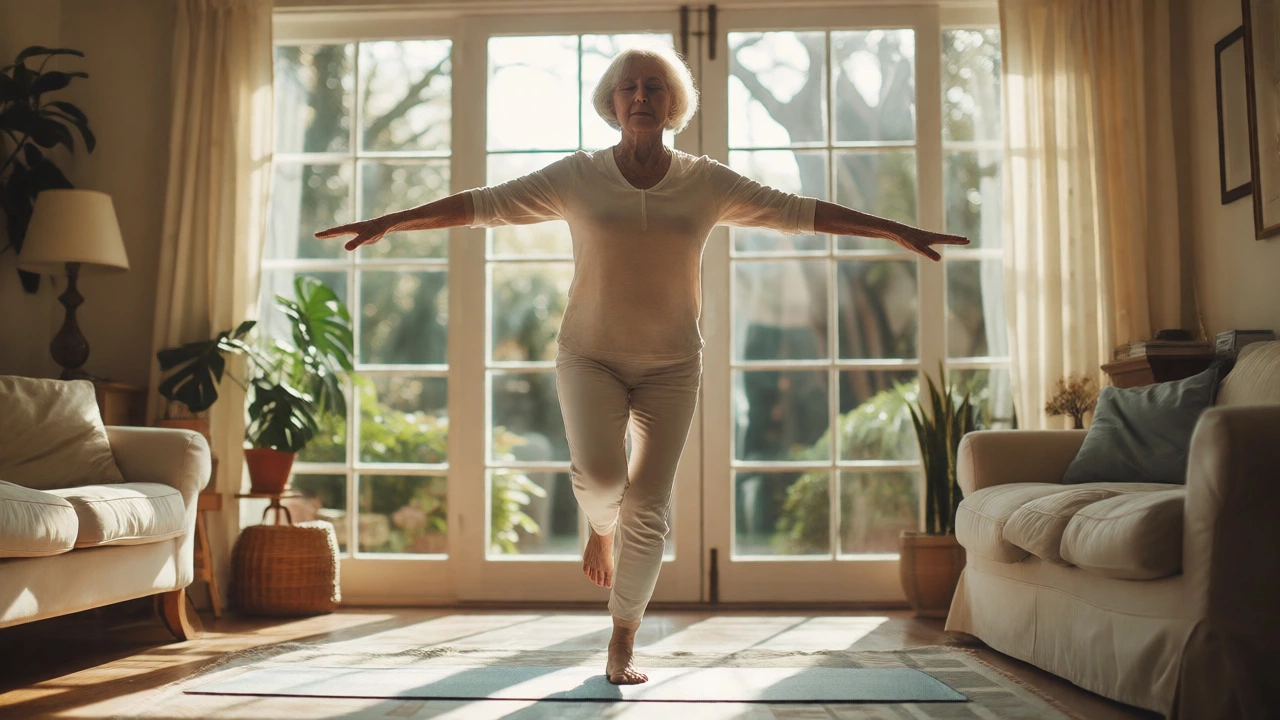
Falls are the leading cause of injury-related death in adults over 65. Strength and cardio won’t save you if you can’t balance. Incorporating mobility work and balance exercises into your routine is crucial for maintaining agility. Yoga, tai chi, or simple single-leg stands while brushing your teeth can make a huge difference.
A study in the British Journal of Sports Medicine highlighted that balance training reduces fall risk by up to 30%. Start with heel-to-toe walks. Progress to standing on one leg with eyes closed. These exercises retrain your proprioception-your body’s ability to sense its position in space. Keeping this skill sharp ensures you remain confident in your movements, which is essential for mental well-being as you age.
How to Start: A Simple Weekly Plan
You don’t need a complex program. Consistency matters more than perfection. Here’s a realistic schedule for someone starting from scratch:
- Monday: Full-body strength training (squats, push-ups, rows). Focus on form, not weight.
- Tuesday: 45-minute Zone 2 walk or cycle. Keep your heart rate moderate.
- Wednesday: Rest or light stretching/yoga.
- Thursday: Full-body strength training. Add a little more weight or reps.
- Friday: HIIT session. 20 minutes total, including warm-up and cool-down.
- Saturday: Active leisure. Hiking, swimming, or a long bike ride. Make it fun.
- Sunday: Complete rest. Prioritize sleep and recovery.
This plan hits all the major bases: cardiovascular health, muscle preservation, and flexibility. Adjust based on your current fitness level. If you’re injured or have medical conditions, consult a healthcare provider before starting.
Common Mistakes That Age You Faster
Even with good intentions, people often sabotage their efforts. Overtraining is real. Doing too much HIIT without adequate recovery increases cortisol, which can break down muscle and store fat. Another mistake is neglecting protein intake. Older adults need more protein per meal to stimulate muscle synthesis. Aim for 25-30 grams of quality protein three times a day.
Also, don’t ignore sleep. Exercise causes micro-tears in muscles; sleep repairs them. Poor sleep disrupts hormones that regulate hunger and stress, making it harder to maintain a healthy weight. Protect your sleep like you protect your workout time.
Is running bad for your joints as you age?
No, recreational running is generally safe and beneficial for joint health. Studies show that runners have lower rates of osteoarthritis than non-runners. However, sudden increases in volume or poor form can lead to injury. Gradual progression and proper footwear are key.
How quickly can I improve my VO2 max?
You can see noticeable improvements in 4-6 weeks with consistent HIIT and aerobic training. Significant changes typically occur within 3-6 months. Genetics play a role, but everyone responds to training to some degree.
Do I need to go to the gym to get anti-aging benefits?
Not necessarily. Bodyweight exercises, hiking, cycling, and dancing can provide similar benefits. The key is meeting the recommended guidelines for aerobic activity and muscle-strengthening activities, regardless of location.
What is the best exercise for brain health?
Aerobic exercise is strongly linked to improved cognitive function and reduced risk of dementia. Activities that combine physical and mental challenges, like tennis or dance, offer additional benefits due to the coordination and strategy required.
Can I start strength training at 60?
Absolutely. It’s never too late to build muscle. Older adults can gain strength and muscle mass at rates comparable to younger individuals when following a progressive resistance training program. Start with lighter weights and focus on technique.