Boxing Matches June 7, 2026
Boxing Weight Classes Explained: From Flyweight to Heavyweight
Boxing Weight Class Explorer
Find Your Division
Enter your current fighting weight to see which professional weight class you belong to.
Ready to Fight?
Enter your weight on the left to discover your official professional boxing weight class.
Official Division
--
--
-- lbs
-- kg
-- kg
Characteristics
--
Analysis
--
Note: --
Quick Reference Guide
Walk into any gym or tune into a Saturday night fight card, and you’ll hear terms like "Heavyweight," "Welterweight," or "Featherweight" thrown around casually. But have you ever stopped to wonder why these specific names exist? Why isn’t there just one big category where the biggest guy fights the smallest? The answer is simple: safety and fairness. Boxing is brutal enough without adding a massive size disadvantage to the mix.
If you are new to the sport, the sheer number of divisions can be overwhelming. There isn't just one list; there are different systems for amateurs and professionals, and even within professional boxing, the four major sanctioning bodies have slightly different rules. This guide breaks down exactly what boxing categories are called, how they are measured, and why those measurements matter so much.
The Core Logic: Why Weights Matter
Before diving into the numbers, it helps to understand the philosophy. Boxing divides fighters by Weight Class, which is a category based on a fighter's body mass to ensure competitive balance. The logic is straightforward: a 150-pound fighter generally has more power than a 110-pound fighter. If they fought each other, it wouldn’t be a test of skill; it would be a slaughter.
However, weight isn't the only factor. Height, reach (the distance from fingertip to fingertip with arms outstretched), and leverage also play huge roles. That’s why you sometimes see a shorter, stockier boxer beating a taller, rangier opponent in the same division. But weight remains the primary filter because it’s objective. You can step on a scale. You can’t easily measure "heart" or "skill" before the bell rings.
Professional Boxing Divisions: The Big Four
In professional boxing, the landscape is governed by four major organizations: the World Boxing Council (WBC), the World Boxing Association (WBA), the International Boxing Federation (IBF), and the World Boxing Organization (WBO). While they mostly agree on the main divisions, they differ on the "champion" belts and some minor weight limits.
Most pro boxing uses pounds as the standard unit. Here is how the professional hierarchy stacks up, from the lightest to the heaviest:
| Weight Class Name | Weight Limit (lbs) | Weight Limit (kg) | Notable Characteristics |
|---|---|---|---|
| Minimumweight (Strawweight) | 105 lbs | 47.6 kg | The lightest division. Incredible speed, less power. |
| Light Flyweight | 108 lbs | 49.0 kg | Slightly larger frame, still relies on agility. |
| Flyweight | 112 lbs | 50.8 kg | Historically popular in Asia and Latin America. |
| Super Flyweight | 115 lbs | 52.2 kg | A bridge between pure speed and emerging power. |
| Bantamweight | 118 lbs | 53.5 kg | Known for technical boxers and high stamina. |
| Super Bantamweight (Junior Featherweight) | 122 lbs | 55.3 kg | Often features aggressive punchers. |
| Featherweight | 126 lbs | 57.2 kg | A classic division with many legendary champions. |
| Super Featherweight (Junior Lightweight) | 130 lbs | 58.9 kg | Fighters here often have significant knockout power. |
| Lightweight | 135 lbs | 61.2 kg | Considered the pinnacle of technical boxing skill. |
| Super Lightweight (Junior Welterweight) | 140 lbs | 63.5 kg | A transition zone towards heavier, more powerful styles. |
| Welterweight | 147 lbs | 66.7 kg | One of the most popular TV divisions. Fast and hard-hitting. |
| Super Welterweight (Junior Middleweight) | 154 lbs | 69.9 kg | Physical battles common here due to increased mass. |
| Middleweight | 160 lbs | 72.6 kg | Historically home to all-around greats like Sugar Ray Robinson. |
| Super Middleweight | 168 lbs | 76.2 kg | Often seen as the toughest division physically. |
| Light Heavyweight | 175 lbs | 79.4 kg | Power becomes dominant; speed starts to drop. |
| Cruiserweight | 200 lbs | 90.7 kg | Heavy hands, but still requires movement. |
| Heavyweight | No limit | No limit | The undisputed top tier. Pure power and size. |
Notice the pattern? Every time you go up a class, the weight jumps by about 3 to 5 pounds, except for the big jump at Cruiserweight. Also, note that "Super" usually means the upper end of a range, while "Junior" is an older term for the same thing (e.g., Super Featherweight is the same as Junior Lightweight).
Amateur vs. Professional: A Different World
If you watch the Olympics or world championships, you might notice something strange: the weight classes don't match the pro lists above. That’s because amateur boxing, now largely governed by IBA (International Boxing Association) and AIBA historically, uses kilograms and has fewer divisions. They also separate men and women strictly, whereas pro boxing has mixed promotional structures but distinct belts.
Amateur boxing focuses more on points scoring than knockouts. Therefore, their weight classes are designed to keep matches close in physical stature to allow technical point-scoring to shine. For example, the Olympic men’s divisions typically range from Light Flyweight (49 kg) to Heavyweight (+92 kg). Women’s divisions start lower, around 48 kg.
Why does this matter to you? Because many future pros start as amateurs. When a fighter turns pro, they often "move up" in weight. An amateur Light Welterweight might become a pro Welterweight. Understanding this shift helps explain why some fighters look bigger when they turn professional-they’ve had years to bulk up safely under supervision.

The "Climbing the Ladder" Strategy
You won’t always see fighters stay in one weight class forever. In fact, moving up is the norm as boxers age. Muscle mass increases, metabolism slows, and maintaining a strict 126-pound diet becomes miserable and unhealthy. So, a Featherweight might move to Super Featherweight, then Lightweight, and so on.
This creates interesting dynamics. A fighter who moves up two or three classes quickly might struggle because they’re fighting people who naturally weigh more and hit harder. On the flip side, a heavyweight who drops down to Light Heavyweight can dominate simply by being bigger and stronger than everyone else. This is called "dropping weight," and it’s a risky strategy if the fighter loses too much muscle or energy.
Conversely, "moving up" is safer for health but harder for success. You lose your size advantage. That’s why champions often defend their titles multiple times before considering a move. They want to establish themselves as the best in their current bracket first.
Special Cases: Catchweights and Non-Title Fights
Not every fight happens at a standard weight. Sometimes, promoters negotiate a "catchweight." This is a custom weight agreed upon by both camps, usually when one fighter is too heavy for the official limit but not quite ready to move up a full class. For example, if a Welterweight (147 lbs) wants to fight a Super Welterweight (154 lbs), they might agree to a 150-lb catchweight.
Catchweights are common in non-title bouts or mega-fights where money talks louder than tradition. They can be controversial because they blur the lines of fairness. Is it really a fair fight if one guy is carrying extra poundage? Often, yes-but it depends on how well each fighter handles the weight cut.
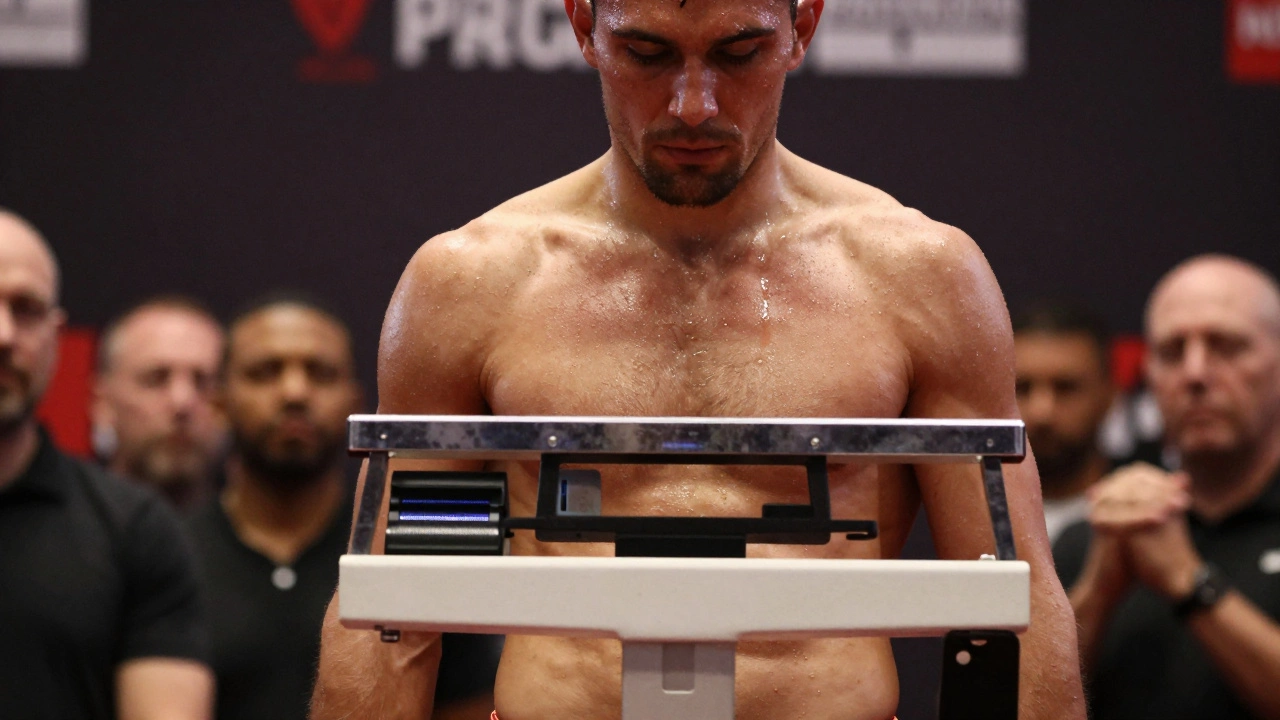
Speaking of weight cuts: this is the dark side of boxing categories. Fighters often dehydrate themselves severely to make weight on fight day, then rehydrate rapidly afterward. A fighter listed at 154 lbs might actually weigh 170 lbs after the fight. This practice is dangerous and has led to stricter regulations in recent years, including mandatory hydration tests in some jurisdictions.
How Belts Work Within Categories
Each weight class has its own set of championship belts. In professional boxing, you can be a champion in one weight class and a nobody in another. The belts are awarded by the four major bodies mentioned earlier: WBC, WBA, IBF, and WBO.
To hold a "Unanimous Championship," a fighter must hold belts from all four organizations simultaneously. This is rare. More often, you’ll see "Lineal Champions"-the guy who beat the last recognized champ, regardless of belts-or "Interim Champions," who step in when the real champ is injured or inactive.
Understanding belts helps you follow the news. When you hear "Canelo Alvarez defends his middleweight title," you know he’s staying at 160 lbs. If he moves to Super Middleweight, he’s starting fresh in a new category, even if he’s still considered a superstar.
Common Mistakes Fans Make
New fans often confuse similar-sounding names. Remember:
- Featherweight is NOT Super Featherweight. There’s a 4-pound gap.
- Light Heavyweight is NOT Heavyweight. The jump is 25 pounds!
- Cruiserweight is a bridge between Light Heavyweight and Heavyweight, not a synonym for either.
Also, don’t assume a higher weight class means better boxing. Lightweight boxing is often faster and more technical than Heavyweight boxing. Heavyweights rely more on power and durability because they can’t move as fast. Skill levels vary wildly across all divisions.
Final Thoughts on Boxing Categories
Boxing categories aren’t just arbitrary labels. They are the backbone of the sport’s integrity. Without them, the sweet science would collapse into chaos. Whether you’re watching a gritty bantamweight slugfest or a heavyweight showdown, knowing the weight class gives you context. It tells you what to expect: speed versus power, endurance versus explosiveness.
Next time you watch a fight, check the weigh-in results. See how close the fighters are to the limit. Notice if one fighter looks drained from dehydration while the other looks comfortable. Those details add depth to the spectacle. And remember, the name of the class matters less than the story inside the ropes.
What is the difference between amateur and professional boxing weight classes?
Amateur boxing (like the Olympics) uses kilograms and has fewer divisions, focusing on point-scoring fairness. Professional boxing uses pounds, has more granular divisions (including "Super" and "Junior" variants), and allows for more variation in fighting styles due to the knockout focus.
Why are there so many similar names like Featherweight and Super Featherweight?
These names reflect small increments in weight limits. "Super" indicates the upper end of a weight range (e.g., Super Featherweight is 130 lbs, while Featherweight is 126 lbs). This allows fighters to compete against others of very similar size, ensuring safety and competitive balance.
Can a boxer change weight classes during their career?
Yes, most boxers move up in weight as they age and gain muscle mass. Moving down is rarer and riskier, as it requires losing natural size and strength. Some fighters also move between adjacent classes (e.g., Welterweight to Super Welterweight) to chase titles or better paydays.
What is a catchweight in boxing?
A catchweight is a mutually agreed-upon weight limit for a specific fight that doesn’t correspond to a standard championship division. It’s often used when fighters from different weight classes want to meet, or when a fighter is slightly over their usual limit.
Which weight class is considered the most prestigious?
The Heavyweight division is traditionally seen as the most prestigious because it represents the ultimate test of size and power. However, Lightweight and Middleweight divisions are often cited as having the highest technical skill levels. Prestige is subjective and varies by era and region.