
Golf January 11, 2026
What Is a Golf Shot Called? Common Shots and Their Names Explained
Golf Shot Selector
What's Your Situation?
Enter your current golf course conditions to find the right shot for your situation.
Recommended Shot
When to use:
Ever watched a pro golfer hit a shot and heard the commentator say "that's a punch shot" or "perfect fade" and wondered what they meant? Golf isn't just about swinging a club-it’s a language of its own. Each shot has a name, a purpose, and a technique behind it. Knowing these terms isn’t just for show; it helps you talk to your playing partners, understand lessons, and actually improve your game.
Basic Golf Shots and What They’re Called
The most common shot in golf is the drive. That’s the big swing you use off the tee on par-4s and par-5s. You’re trying to get maximum distance with a driver, usually a 10-15 degree club. A good drive lands in the fairway, not the rough, and sets up your next shot.
Then there’s the iron shot. These are used when you’re closer to the green and need precision over power. Golfers use 3-iron to 9-iron depending on distance. A 7-iron might be used from 140 yards out. Iron shots are about control, not speed.
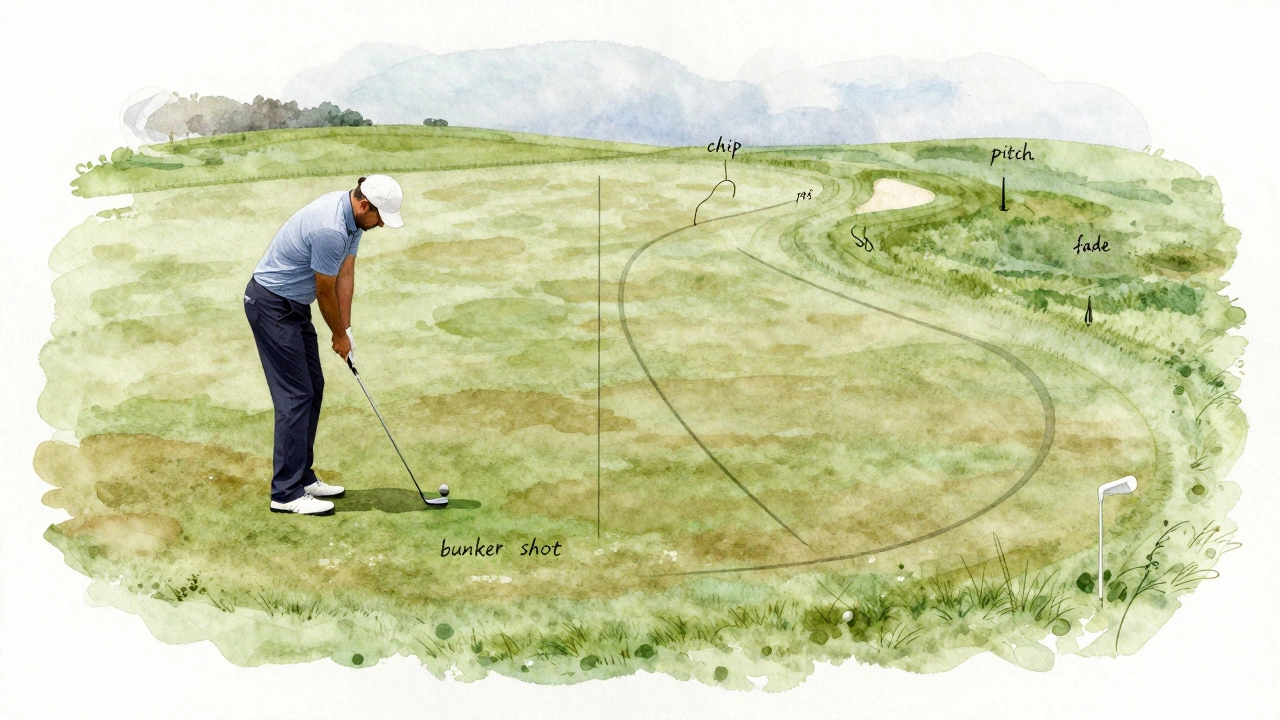
When you’re right next to the green and need to get the ball up quickly, you use a chip shot. It’s a short, low-trajectory swing with a wedge-usually a 52°, 56°, or 60° club. The ball rolls more than it flies. A good chip lands softly and rolls toward the hole.
If you’re stuck just off the green with a bunker or rough in the way, you’ll use a pitch shot. This is a higher, softer shot than a chip. You open the clubface, take a little more swing, and let the ball fly higher and land with less roll. Pitch shots are for when you need to clear something and stop the ball fast.
Specialty Shots You’ll Hear on TV
Pro golfers don’t just hit basic shots. They shape the ball to fit the hole. That’s where terms like fade and draw come in.
A fade is a shot that curves gently from left to right for a right-handed golfer. It’s not a slice-it’s controlled. Many pros use it on dogleg right holes to avoid trees or bunkers. A draw does the opposite: it curves from right to left. It’s often used to navigate dogleg left holes or to get extra roll on firm fairways.
Then there’s the hook and the slice. These are mistakes, not techniques. A hook curves too hard left; a slice curves too hard right. Both usually happen because of poor clubface alignment or swing path. If you’re hitting one of these often, it’s time to check your grip or posture.
Another shot you’ll hear called is the punch shot. This is a low, penetrating shot used when it’s windy or you’re under tree branches. You shorten your backswing, keep your hands low, and make a compact swing. The ball stays under the wind and rolls out more after landing.
And then there’s the bunker shot, or sand shot. This isn’t just hitting the ball out of sand-it’s hitting the sand behind the ball. You open the clubface, dig in with your feet, and let the sand lift the ball out. A good bunker shot doesn’t need to be powerful-it needs to be clean.

What About Putts?
Yes, putting counts as a shot too. But in golf, not all putts are the same. A birdie putt is one you need to make to finish a hole one under par. A par putt keeps you even. A long putt might be 20 feet or more. A short putt is under 3 feet-those are the ones you miss when you’re nervous.
There’s also the break-the curve the ball takes on the green because of slope. Reading the break is half the battle. A right-to-left break means the ball will curve left as it rolls. You aim right of the hole to compensate.
Some golfers use a frog putt or long putter to reduce wrist movement. Others stick with the traditional method. Either way, the goal is the same: get the ball in the hole in as few strokes as possible.
When Do You Use Each Shot?
Choosing the right shot isn’t random. It’s about the situation:
- Off the tee on a long hole? Use a drive.
- 150 yards out with no hazards? Use a 7-iron.
- Just off the green with a 10-foot roll to the hole? Use a chip.
- Same spot, but a bunker is in the way? Use a pitch.
- Wind blowing hard? Use a punch shot.
- Ball in a greenside bunker? Use a bunker shot.
- On the green, 8 feet away? Use a putt.
Knowing what shot to use when is what separates good golfers from great ones. It’s not about having the fanciest club-it’s about knowing which one to pick and how to swing it.
Common Mistakes Beginners Make
New golfers often confuse terms. They think a slice is a fade. They think a chip and a pitch are the same. They try to use a driver on every hole. Here’s what to avoid:
- Don’t try to hit a draw if you don’t know how. It’s not a magic fix.
- Don’t use a wedge for long chips-it’ll send the ball flying too high and stop too soon.
- Don’t swing harder to get more distance. A smoother, more controlled swing gives better results.
- Don’t ignore the wind. A 10 mph breeze can change your shot by 15 yards.
Practice each shot separately. Spend 15 minutes on chipping. Then 15 on pitching. Then bunker shots. You’ll start seeing the difference in your scorecard.
Why Knowing Shot Names Matters
It’s not just about sounding smart on the course. When you say, "I need a 56-degree wedge for a pitch shot," your caddie or coach knows exactly what you mean. When you watch a tournament and hear "he’s laying up with a 7-iron," you understand the strategy. You start seeing the game differently.
It also helps you learn faster. If your instructor says, "Your swing path is causing a slice," you know what to fix. If you just say, "My ball keeps going right," you’re stuck.
Golf is a game of details. The name of a shot tells you how it’s made, why it’s used, and how to fix it when it goes wrong.
What is the most common golf shot?
The most common golf shot is the drive, used off the tee on par-4s and par-5s. It’s hit with a driver and aims for maximum distance. But in terms of total strokes per round, putts are actually the most frequent-most golfers take 30+ putts per round.
What’s the difference between a chip and a pitch?
A chip shot is low and rolls more than it flies-used when you’re close to the green with a clear path. A pitch shot is higher and lands softer, used when you need to clear rough, bunkers, or stop the ball quickly. The key difference is trajectory and roll.
Is a fade better than a draw?
Neither is better-it depends on the hole. A fade works well on dogleg right holes and in windy conditions because it’s more stable. A draw can add distance on firm fairways and helps on dogleg left holes. Most pros can hit both, and they choose based on the situation.
What shot do you use out of a bunker?
You use a bunker shot, also called a sand shot. Open the clubface, dig your feet into the sand, and swing so you hit the sand about an inch behind the ball. The sand lifts the ball out. Don’t try to hit the ball directly-it will bounce off the sand and go nowhere.
Can you use a driver on the fairway?
Yes, but it’s risky. Drivers are long and hard to control from the fairway, especially if the lie isn’t perfect. Most golfers use a fairway wood or hybrid instead. Only pros with high swing speeds and perfect technique use drivers off the fairway regularly.
Why do pros hit a punch shot?
Pros use a punch shot when the wind is strong, or when they’re under trees and need to keep the ball low. It’s a compact swing with a shorter backswing and follow-through. The ball flies lower, cuts through the wind, and rolls out more after landing.