
Running May 21, 2026
How Quickly Do You Lose Fitness After a Marathon? (The Detraining Timeline)
Marathon Detraining Timeline Calculator
wks
Tip: Adjust the slider or input field to see how different break durations affect your aerobic capacity and running economy.
Physiological Status Report
Enter weeks off and click calculate to view data.
That feeling of standing on the finish line, arms raised, knowing you just ran 26.2 miles is unmatched. But the high doesn't last forever. Within days, the adrenaline fades, and a nagging question creeps into your mind: How quickly am I losing all that hard-earned fitness?
If you’ve ever taken a week off after a big race, you might have felt like your legs turned to lead during a casual jog. It’s frustrating. You trained for months, only to feel like a beginner again in a matter of weeks. The truth is, your body doesn’t switch off overnight, but it does start dismantling its adaptations faster than you think.
Understanding the timeline of marathon detraining isn’t just about fear-mongering; it’s about strategy. Whether you’re planning a break, dealing with an injury, or transitioning to a new sport, knowing exactly what happens to your physiology can help you maintain gains and return to peak form without starting from zero.
The First Week: Fatigue vs. Fitness
In the immediate aftermath of a marathon, your body is in a state of shock. You are likely experiencing significant muscle damage, depleted glycogen stores, and systemic inflammation. This isn’t “losing fitness” yet; this is simply being tired.
Most runners take at least three to seven days of complete rest or very light activity after finishing. During this time, your heart rate may remain elevated, and your resting blood pressure might drop slightly due to reduced sympathetic nervous system drive. However, your actual aerobic capacity-your ability to transport and use oxygen-remains largely intact.
Here’s the good news: Your mitochondria (the power plants of your cells) and capillary density don’t vanish in a week. If you jump back into a moderate run after five days, you might feel heavy, but your lungs will still remember how to work. The perceived effort feels higher because your muscles are sore, not because your engine has broken down.
- Days 1-3: Complete rest or gentle walking. Focus on hydration and protein intake to repair micro-tears in muscle fibers.
- Days 4-7: Light jogging or cross-training (cycling, swimming). Keep intensity low (Zone 1/2). This promotes blood flow without adding stress.
Weeks 2-4: The Aerobic Cliff
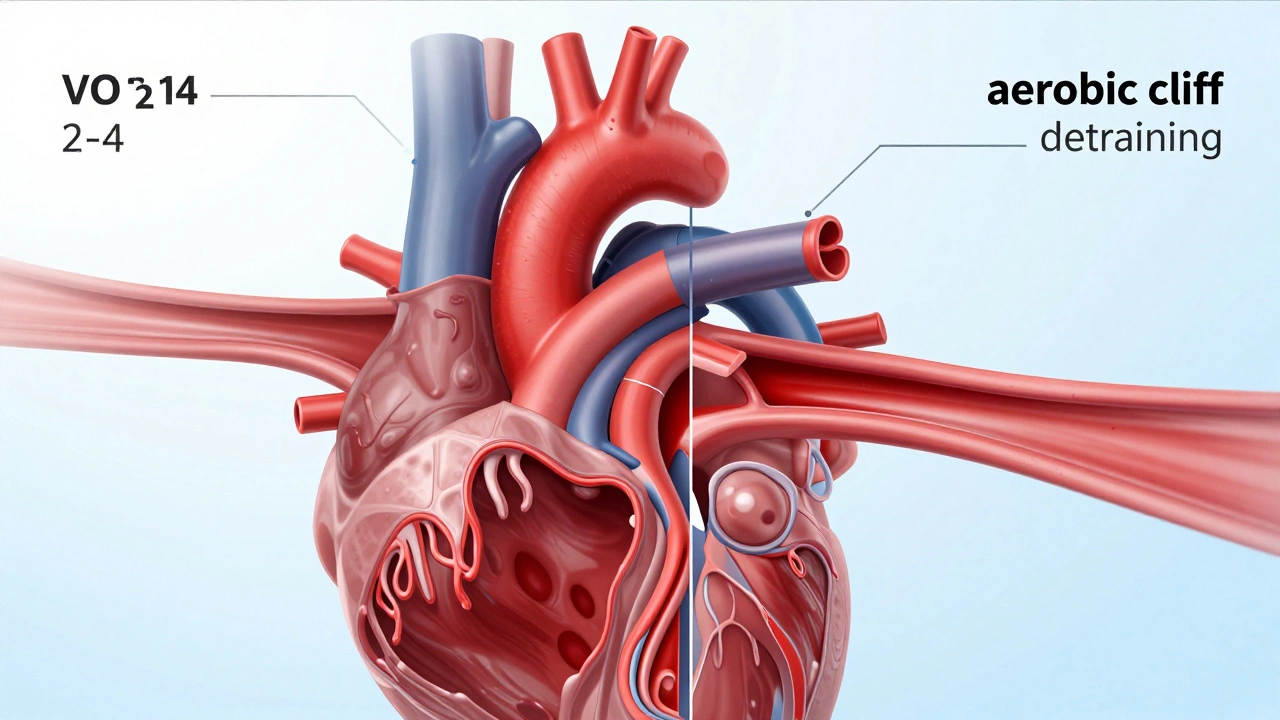
This is where things get interesting. Research shows that the most rapid decline in aerobic fitness occurs within the first two to four weeks of stopping structured training. Your VO2 max, which measures the maximum amount of oxygen your body can utilize during intense exercise, begins to drop.
Studies indicate that VO2 max can decrease by approximately 5% to 10% within the first month of detraining. For a runner with a VO2 max of 50 ml/kg/min, that’s a loss of 2.5 to 5 points. It sounds small, but in competitive terms, it translates to slower pace times. A 5% drop in VO2 max roughly equates to a 30-second to one-minute slowdown per mile, depending on your baseline speed.
Why does this happen so fast? Your plasma volume decreases. When you stop sweating and stressing your cardiovascular system regularly, your body sheds excess fluid to conserve energy. Less plasma means less blood volume pumped per heartbeat, forcing your heart to beat faster to deliver the same amount of oxygen. This makes every run feel harder, even if your muscles are still strong.
| Metric | Change | Impact on Running |
|---|---|---|
| VO2 Max | -5% to -10% | Reduced top-end speed and endurance ceiling |
| Plasma Volume | Decreases significantly | Higher resting heart rate, earlier fatigue |
| Mitochondrial Density | Minimal change | Aerobic base remains relatively stable |
| Muscle Glycogen Storage | Returns to normal | Better fuel availability once rested |
Months 2-3: Strength and Efficiency Fade
If you haven’t picked up a pair of running shoes by now, the changes become more structural. While your aerobic engine is still recognizable, your muscular efficiency starts to slip. Neuromuscular coordination-the communication between your brain and your leg muscles-begins to degrade.
You might notice your stride feels “loose” or inefficient. This is because the specific motor patterns you developed over months of training are fading. Additionally, slow-twitch muscle fibers, which are crucial for long-distance endurance, start to lose some of their oxidative capacity. They don’t disappear, but they become less effective at burning fat for fuel, forcing your body to rely more on carbohydrates earlier in the run.
Strength loss is slower than aerobic loss. You won’t look weak after two months off, but your running economy (the oxygen cost of maintaining a given pace) worsens. Studies suggest that running economy can deteriorate by 1% to 2% per month of inactivity. Over three months, that’s a noticeable difference in how much energy you waste with each step.
The Myth of “Starting From Zero”
Here’s the silver lining: You never truly go back to square one. This phenomenon is known as muscle memory, or more accurately, myonuclear domain theory. When you train, your muscle cells add extra nuclei to support growth and endurance. Even when those muscles shrink during detraining, the nuclei remain dormant for years, sometimes decades.
When you resume training, these existing nuclei allow your muscles to rebuild strength and endurance much faster than when you first started. A seasoned marathoner who takes three months off will regain their previous fitness level in about half the time it took them to build it initially. A novice would need six to nine months to reach that same peak; you might do it in three.
This is why former athletes often dominate local races after returning from long breaks. Their bodies remember the workload. The key is consistency upon return. Don’t try to pick up where you left off. Start at 50% to 70% of your previous mileage and gradually increase. Your joints and tendons need time to re-adapt to impact forces, even if your heart is ready.

How to Minimize Fitness Loss
If you know you’ll be taking time off-whether for travel, injury, or life demands-you can mitigate the damage. You don’t need to run 50 miles a week to hold onto your fitness. Maintenance requires far less effort than acquisition.
To preserve your aerobic base, aim for at least two short runs per week (20-30 minutes) and one longer effort (45-60 minutes) once every two weeks. This minimal dose keeps your plasma volume stable and signals to your body that it still needs to maintain mitochondrial density. Cross-training like cycling or swimming can also help maintain cardiovascular health without the impact stress of running.
Nutrition plays a role too. Maintain adequate protein intake (1.6-2.2 grams per kilogram of body weight) to prevent muscle breakdown. Stay hydrated to support blood volume. And don’t ignore strength training. Two sessions a week of basic lower-body exercises (squats, lunges, calf raises) can keep your neuromuscular connections sharp and protect against injury when you return to full training.
Returning to Training: A Smart Approach
When you’re ready to lace up again, resist the urge to chase your old pace. Your mental expectation will outpace your physical reality. Start with easy, conversational-paced runs. Focus on time on feet rather than distance or speed.
- Weeks 1-2: Run 2-3 times per week for 20-30 minutes. Keep heart rate low. Add one strength session.
- Weeks 3-4: Increase frequency to 3-4 runs. Introduce one slightly longer run (45 mins). Begin gentle hill repeats to rebuild power.
- Weeks 5-8: Gradually increase weekly mileage by no more than 10% per week. Reintroduce interval training cautiously.
Listen to your body. Soreness is normal; sharp pain is not. If you feel unusually fatigued, take an extra rest day. Your cardiovascular system may recover faster than your connective tissues, making you prone to injuries like shin splints or IT band syndrome if you ramp up too quickly.
How long does it take to lose marathon fitness completely?
You never lose it completely due to muscle memory, but significant aerobic decline happens within 4-8 weeks of total inactivity. After 3 months, you’ll feel noticeably slower, but you’ll regain fitness faster than a beginner.
Can I maintain marathon fitness with only two runs a week?
Yes, for maintenance purposes. Two short runs and one longer effort every other week can preserve most of your aerobic base. However, you won’t improve performance or handle race-day intensity without more volume.
Does cross-training help prevent fitness loss?
Absolutely. Cycling, swimming, or rowing maintains cardiovascular health and plasma volume. It’s especially useful if you’re injured and can’t run, as it prevents the rapid drop in VO2 max associated with total sedentary behavior.
Why do I feel slower immediately after a marathon?
This is acute fatigue, not permanent fitness loss. Muscle damage, glycogen depletion, and central nervous system exhaustion make movement feel heavy. Most runners return to pre-race form within 2-3 weeks of proper rest and gradual reloading.
Is it better to take a full break or keep running lightly after a marathon?
A mix is ideal. Take 3-7 days of active recovery (walking, yoga, light cycling), then transition to easy runs. Complete sedentary breaks beyond two weeks accelerate fitness loss, while continuous hard running increases injury risk.